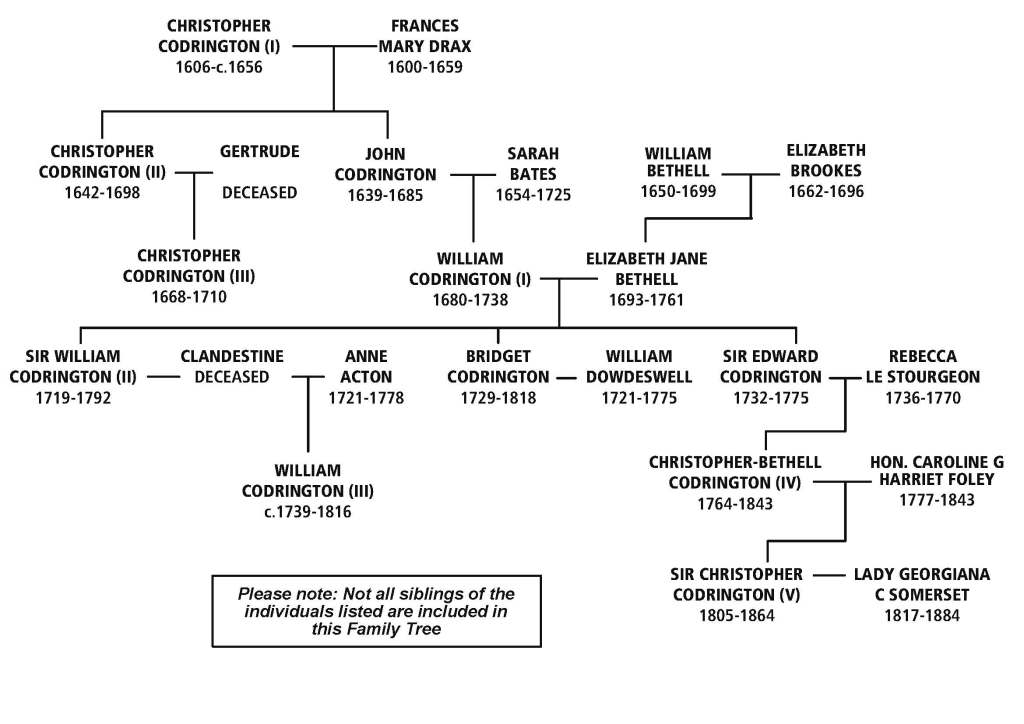
I have named the Codrington’s in date order with the suffix of an I-V.1
The irony about this family, accused of such slave-based wealth, is that their story commenced with their being political refugees. Although the family had been founded in the reign of King Henry IV and attained distinction under Henry V in the 100 Years War, their loyalty to the crown in the English Civil War (1642-1649) saw Christopher Codrington (I) (1606-1656) seek refuge in the West Indies.
Christopher Codrington (III) (1668-1710), did not marry and have issue, so he was succeeded by his Uncle John Codrington. He was father to William Codrington (I) (1680-1738) who was created the 1st hereditary Baronet in 1721. His bride was a wealthy slave-owning Bethell. Aristocratic marriages were then inspired firstly by wealth rather than love.
They produced Sir William Codrington (II) (1719-1792). He was a wayward youth who was involved in an illegal“clandestine” marriage. His later marriage to Anne Action in 1836 was legal and did provide issue. However, their son, Sir William Codrington (III) was another wayward youth and was officially disinherited by his father. He fought the decision legally and his issue was regarded as Baronet until 1876. However, he did not, receive the family’s wealth. William Codrington (II) was MP for Tewkesbury successively from 1761 and his death in 1792 caused a by-election, which became embroiled in the Anti-Slavery Controversy. He was eventually succeeded by Captain William Dowdeswell (III) (1760-1828),2 whose father a Whig Cabinet minister had married William Codrington’s (II) sister, Bridget. Capt. Dowdeswell convinced some that he favoured of the Abolition of Slavery, but he resigned as MP in 1797 and returned to his former military career. He was appointed Governor of the Bahamas from 1797 to 1802 and from there promoted to Major-General, being made Commander-in-Chief in India in 1807.3 He died in 1828 without legal issue.
The Codrington family then returned in 1797 as Tewkesbury’s MP with the election of Christopher Bethell-Codrington, the nephew of Sir William Codrington (II) by his brother Sir Edward Codrington. In 1758 he added the name Bethell to benefit from that family’s legacy. He remained our MP until 1812 (as one of two MPs with James Martin and Charles Hanbury-Tracy). In 1806, he rejected pressure from his constituents to support the abolition of the slave trade but denied being motivated by his self-interest as a plantation owner. Later in 1832, he had a very public debate in the newspapers on abolition, claiming the supposed contentedness of the slaves in Barbuda. In 1838 the British government emancipated the slaves, and Bethell-Codrington (and family) was compensated at least over £31,000 (in 2023 valued at £3.54m) for nearly 2,002 slaves in his ownership over three islands.4He died on 3 February 1843, with at least 5 children as issue, including three males as heirs to the family wealth.
He was succeeded as MP by John Edmund Dowdeswell, who does not seem to have received any compensation from slavery.5
John Codrington and Sarah Bates also had a son named Christopher who is not named in this Family Tree. ↩︎
There were five William Dowdeswell’s who were MPs for Tewkesbury. ↩︎
His life would make an interesting biographical article. ↩︎
Sir Christopher Bethell Codrington soi-disant Bart., UCL Centre for the Study of the Legacies of Slavery, <https://www.ucl.ac.uk/lbs/person/view/470> [accessed 3/6/2025]. ↩︎
 Tewkesbury Voices